Trending


Scottish winters don't arrive all at once. They creep in — a cold night in September, a gale in October, then weeks of damp, dark weather that seems to settle over the apiary until March. A colony that was booming on the heather in August can be light, wet and hungry by the turn of the year, and most winter losses trace back to something that could have been sorted months earlier.
The good news is that winter preparation is not complicated. It's a sequence of small jobs done at the right time — feeding while the bees can still take syrup down, insulating before the first hard frost, then keeping your hands out of the hive and your eyes on the weather.
Once the main crop is off and the last supers are cleared, take stock. You want to know three things about every colony: is there a laying queen, is the brood pattern reasonably solid, and how much food is actually in the box.
This is also your last realistic chance to deal with varroa. Thymol-based treatments need mild weather to work properly, so they belong in late summer and early autumn rather than October. If you use oxalic acid, that's a midwinter job — more on that below. Follow the product label and, if you're unsure, ask your local association what's working in your area.
Weak colonies are a gamble in a Scottish winter. A small cluster struggles to keep warm and often fails by February. Uniting a weak colony with a stronger one using a sheet of newspaper between the boxes is usually kinder than watching it dwindle.
Feed thick syrup — roughly two parts sugar to one part water by weight — while the days are still mild enough for the bees to invert and store it. Thin syrup encourages brood rearing, which is the last thing you want going into winter.
Aim for a heavy hive. As a rough guide, a full colony wants somewhere around 20 kg of stores to see it through, and more if it's a large colony or spring arrives late. Heft the hive by lifting the back edge; if it feels light, it is light. Don't guess.
Cold alone rarely kills a colony. Damp does. A cluster can keep itself warm, but if warm, moist air from the bees condenses on a cold crown board and drips back onto them, you get chilled bees, mouldy combs and a miserable spring.
The fix is insulation above the cluster and ventilation below it. An open mesh floor with a thick slab of insulation directly over the crown board works well — the bees stay dry, and moisture escapes downwards rather than dripping. Avoid sealing a hive up tight; a colony needs air moving through it.
Scottish gales lift roofs, tip hives and scatter supers across the field. Before the first big low-pressure system arrives:
In woodland or near farmland, great spotted woodpeckers can drill into hives in winter. Netting or a sheet of mesh wrapped around the boxes is the usual defence. Livestock, deer and even curious ponies will rub against hives — a stock fence is cheaper than a new colony.
Don't open a hive in cold weather unless you genuinely have to. Every inspection breaks the cluster's seal of warm air, and the bees pay for it in stores.
What you can do:
If you use oxalic acid for varroa, the traditional window is the broodless period in midwinter. Check current guidance and the product instructions before you treat, and never guess at doses.
This is when colonies starve. The queen has started laying, brood rearing eats stores fast, and there's often nothing coming in from the fields for weeks. A hive that looked comfortable in January can be desperate by early March.
Keep checking weight and keep fondant on hand. On a mild day you might lift the roof for a quick glance at stores, but resist the urge to pull frames. If you find a colony has died, close it up and investigate later — don't leave wet combs and dead bees sitting open in the apiary.
Bees are quieter in winter, and that's normal. A cluster barely moves, a few bees appear at the entrance on a mild afternoon, and the whole apiary looks forgotten. That's the plan working.
What isn't normal is a hive that's visibly light in December, water pooling inside, or an entrance blocked by snow or dead bees. Those are the moments to act, calmly and quickly.
Every apiary is different — a sheltered corner in Fife behaves nothing like a stand on a Hebridean hillside. Talk to beekeepers nearby, keep notes on what you did and when, and adjust next year. A colony that goes into winter heavy, dry, protected and undisturbed usually comes out of it the same way.
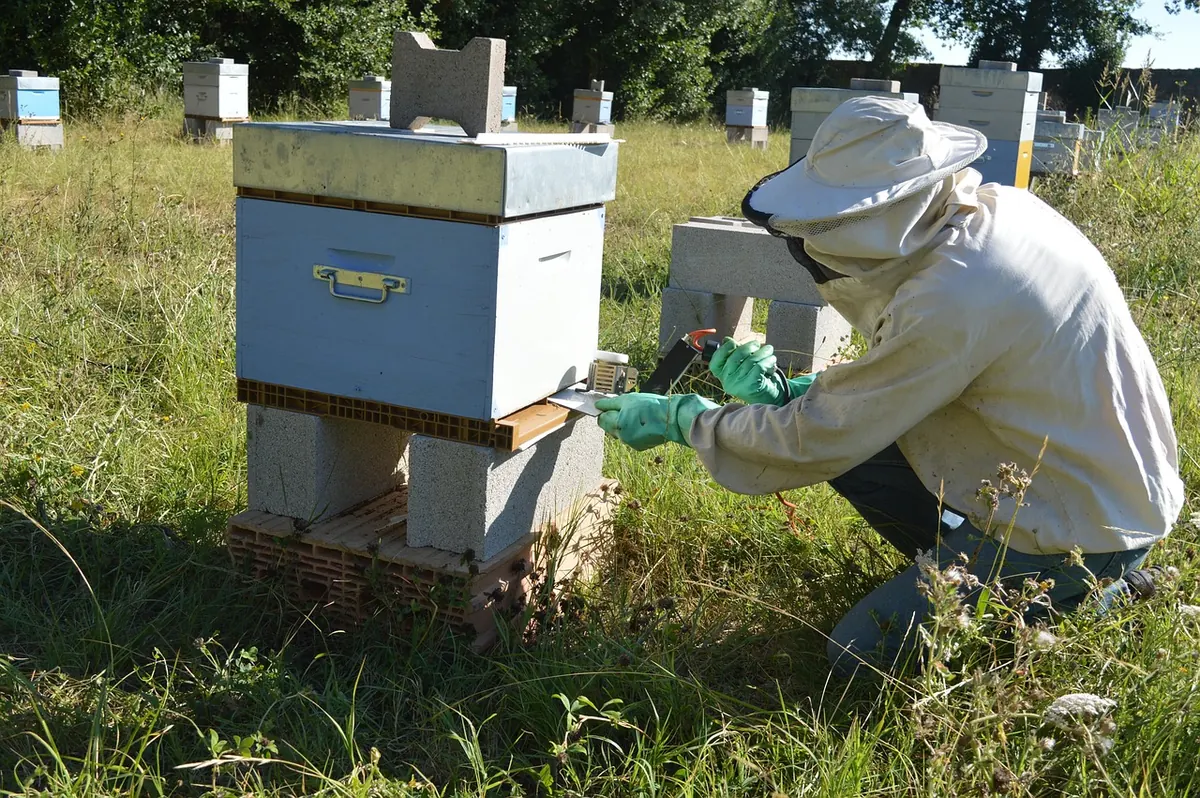
Photo: Juncala / Pixabay